
Last Updated on April 20, 2020
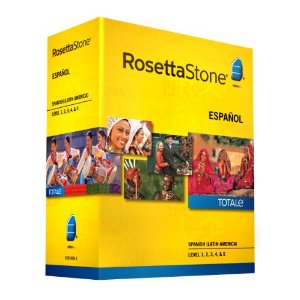
Rosetta Stone Spanish (Latin America) Level 1-5 Set - click on the image to get 36% discount on Amazon
Did you ever experience the frustration of visiting a foreign country and not understanding the language at all? Luckily, English is pretty much international these days. However, when I visited China I had the surprise that many people did not speak anything but Chinese, so my knowledge of three languages was rather useless, as long as I was not able to speak, read or even understand a single Chinese word. Another language worth learning is Spanish. I’d love to visit Latin America some day and I surely want to be prepared better than I was for my Chinese experience.
No Language, No Fun
I felt so frustrated in the beginning, because I always like to talk to people in foreign countries I visit, I enjoy conversation, I want to feel the spirit of places, and for this, I need at least to understand the basics of the language spoken by those people. On my way from the airport to the hotel, I started to pay attention to pictures and signs, and as some of them were bilingual, Chinese-English, one hour later I was able to recognize the Chinese word Beijing, even when it was not accompanied by the English spelling.
No Language, Lots of Fun
That was the beginning of the most amusing game I played for three weeks, the duration of my stay in China. I looked at things, pointed at them and my host was telling me their Chinese names. Then I repeated until I managed to pronounce correctly. Every now and then, we reversed the roles: my Chinese friend pointed at things and I had to name them back in Chinese. I was astonished to discover that I could remember almost everything: it seems like association is the natural learning way of the brain (indeed, children learn their native tongue by making associations).
Why Learning a Foreign Language Naturally Works Best
Back home, I gave it a thought and this is my explanation of my unexpected evolution:
- all progress was made on the spot, with no translation or memorization required
- I had immediate feedback on all attempts: my friend rated my pronunciation on the spot and made the eventual corrections, sol I always knew where I stood
- the learning process was continuous and gradual: we played the game all day round, I never know when she’s going to ask me something, and the topics were more and more difficult every day
It is also true that I’m clever 😉 Now I’m going to learn Spanish, but this time I want to make it a little bit faster, so I’m going to get the Rosetta Stone Spanish Level 1-5 Set
The sample topics include the following:
- Most common questions, greetings, introductions
- Family relations, age and similar stuff to help you started with conversations
- Directions, locations, dining out
- How to tell the time, date-related terms, weather-related terms
- Expressing emotions, ideas and opinions
- Planning to move abroad
- Arranging home repairs
- Conducting interviews
- Tourism and art conversation topics
- Commercial transaction terms
You’ll learn how to read, speak and write in Spanish (or the language you’ve chosen). More important, you’ll learn how to memorize what you learn and how to build your vocabulary and language abilities. The speech recognition will give you confidence in your pronunciation.
Reviews on Amazon are promising. I hope I’ll be able to make quick progress with my Spanish. Here’s what one of the reviews said:
Each screen is accompanied by a phrase, spoken out loud by a native speaker in the program, and four slightly different picture scenes that require you to pick the one that the sentence is referring to. Beginning at a very basic level — such as “the boy is under the tree” (in whatever language) with four pictures of a boy next to, under, in the limbs of and cutting down the tree — your proficiency improves as you move through these basic cues to more advanced and complex speaking and contexts. By the end of the program you are dealing with fairly complex situations, sentences and associations.
I’m tempted by the current deal on Amazon: the complete Level 1-5 Rosetta Stone is only $479, which is 36% off the retail price of $749. That’s a $270 saving. It’s enough to make myself a nice gift.
What foreign languages do you wish to learn? Do you think that speaking many languages can bring you benefits?



Rosetta Stone is an excellent product. Their software is highly renowned in the industry. However, at some point the learner must immerse her/himself in the culture. I studied Spanish for 4 years but it wasn’t until I lived in Mexico and studied there that I really got the flow of speaking.
Hi, Damien, welcome here. I agree with you, living in that culture is very helpful for a better level of learning. There are things not written in any book.
I started learning Turkish on my own some time ago. The method I used is French, it’s called Assimile and it’s been made for most existing languages. It has audio files and a book. I don’t know how natural it is, but I could see the results pretty fast. It requires practicing one hour per day though. Due to lack of time, i stopped for a while.
I used your method of association in Greece, where most signs were bilingual. It does work 🙂 I will try Rosetta Stone when I get back to studying foreign languages.
Gorusuruz 🙂 (I don’t have special characters..)
🙂 Thank you Alina, I did not know about Assimile. I believe that one needs to practice daily, regardless the method used. I’m a big fan of Turkey, I dream to buy a small house in Kusadasi some day. You are invited 🙂
Hehe, thanks! Actually, speaking of this, I am planning to go there next summer. I’ve heard about entire villas rented for 450 euros (10 days). That is an impressive price indeed! So, another fan of Turkey, great to hear that, as I would really love to live in Istanbul for a while 😀
I’m yet to try this method once I get to learning some new language. So far got to improve my English.
I’ve run into idea of associations first here http://www.200words-a-day.com/language-learning-blog-1.html
Hey Sleeping Dude, thanks for your comment. I did not know about your blog.
I’m using Rosetta Stone Latin American to try to learn Spanish. I will eventually (next summer perhaps) take a two week trip down to Mexico and see how I fair.
I just started Unit 7. Yay!
I heard Mexico is a great place to visit. I’m sure you’ll do fine (muy bien?), Ronald.
I used Rosetta Stone and I now live in spain – cool. Nice blog.
I was thinking of checking out Rosetta Stone as I’ve heard only good things about this method.
I’ll probably take Italian as I already know french and english and a tiny bit of spanish. I love foreign languages.
Marie
Hi Marie, thanks for your comment. You know a lot of languages. Do you intend to visit Italy?
Not for the moment. But I’m very interested in learning the language. I have already started a bit on my own with a book and a CD.
Marie
One interesting method to consider in learning a foreign language is to watch American movies in the target foreign language. This approach assumes that the student has some basic familiarity with the language, but it serves as an interesting reinforcement and approach to keep the student from getting board.
I will probably take japanese as I already know english and arabic